
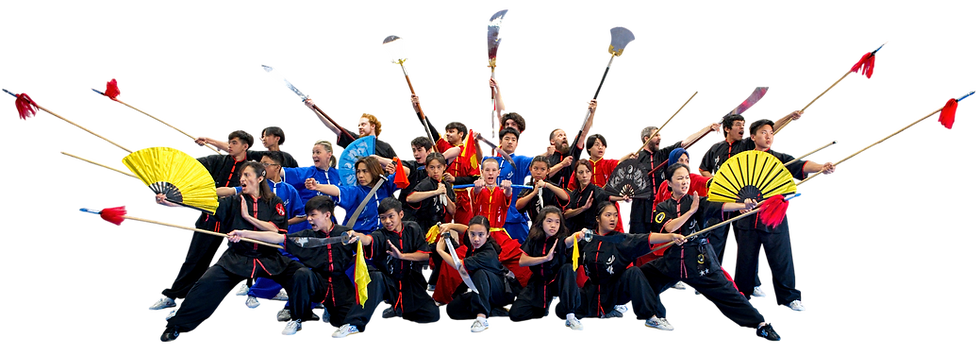

Shaolin Animal Style
Animal forms are also an important and well-known aspect of Shaolin. Masters in the past would patiently watch other living creatures as they attacked for food or defended against predators. Their movements were adapted into human form, and hence came Tang Lang Quan (Praying Mantis Fist), Wu Xing Quan (Five Animals Fist using Dragon, Tiger, Crane, Leopard, and Snake), Hou Quan (Monkey Fist), and so on.
DRAGON STYLE:
Dragon Kung Fu (龍形 Long Ying) form is based on the mythical Chinese dragon. The origin of Dragon Style Kung Fu is not known in its entirety, so only a close approximation exists. It is said that Wu Mui developed the basics of the art in 1570 CE. Since then, the style has evolved into a Northern and a Southern variant.
Techniques of the dragon stylist rely on a variety of fighting methods that can be employed for a wide range of needs. The style uses techniques that can cripple or kill an opponent if the need arises, or it can be used simply to control a minor street-fighting situation. The Dragon Kung Fu practitioner typically attacks with winding, high yang attacks. One signature maneuver is the three-finger claw technique that utilizes the index finger, thumb, and middle finger, or all five fingers, to do hard pinching attacks to the muscles, tendons, and acupressure points, and rapid, close-in palm attacks. Punching techniques can be closed or open-handed. Clawing and grappling techniques, in the imagined style of a dragon, are used. Kicks, no higher than waist level, are used to target sensitive areas such as the groin, knee, and foot. The waist, the largest and most central of all human muscle groups, receives great

focus in Dragon Style. Efforts are made to strengthen, coordinate, and utilize this muscle to achieve powerful and quick movements. For example, when striking with the fist, more power can be exerted when the movement originates from the waist first, then flowing through the body, and finally into the fist. In both the Northern and Southern Dragon Style systems, legwork is characterized by a zigzag motion that mimics the imagined movement of the mythical Chinese dragon. In the Southern style, smaller strides are emphasized to complement the system's short-range combat style. In the Northern system, the strides are greater, utilizing the strength of the legs to move in and out of the opponent's range of attack with speed and force.
TIGER STYLE:
The Tiger Style (黑虎拳) began with Master Wang Zhenyuan in the late nineteenth century, but the style was originally formed at the Shaolin Henan Temple before being transferred to Wang. Tiger Style is one of power, directness, and simplicity. Its primary target is the opponent's throat, and its primary weapons are its fists and claws. All of its efforts are aimed at this one vulnerable target to the exclusion of anything else. It is characterized by its extensive footwork, acrobatic kicks, low, wide stances, and unique fist position (where the thumb is curled in the same manner as the other fingers, rather than wrapped around them). The tiger does not defend, it only attacks, and it does not use blocking techniques but swatting techniques against arms and legs. Key characteristics of a tiger is power, strength, toughness, efficiency, strong legs, arms, and body, as well as strong techniques and a strong mind.

SNAKE STYLE:
Shaolin Snake (蛇拳) Style is one of wisdom, knowledge, precision, experience, and clarity. The Taoist temples of the Wudang Mountains were known to have produced many snake styles. Its style is of a sinuous, fluid motion that prefers to entangle an attacker, make them overextend themselves, then capture, arrest, and force submission. Physically, the Snake would seek to be fit, flexible, and enduring.
Characteristics of this style are based on whipping or rattling power which travels up the spine to the fingers (or, in the case of the rattler, the body shakes which travel down the spine to the tip of the tailbone). The ability to sinuously move, essentially by compressing one's stomach/abdominal muscles, is very important. Footing is quite grounded; the stancework is fluid in order to maximize the whipping potential of any movement. This necessitates building a strong spine to contain the power and strong fingers to convey the strike. Since breathing is important to any movement of the spine and ribs, Snake Style is considered one of the main styles which eventually led to internal training. Snake Style generally aims for weak points of the human body, such as the eyes, groin,

and joints. Precision is also very important to find those important pressure points. It is a style of order and control, not of random strikes—a style of power without violence, speed without haste, and knowledge without dominance. Snake Style Kung Fu is considered to be a highly advanced form of fighting due to the use of internal energy (Chi) and the specialized breathing techniques.
CRANE STYLE:
White Crane Boxing (白鶴拳) is a Southern Chinese martial art which originated in Fujian (福建) province and is now practiced throughout the world. According to oral traditions, the creation of this style is attributed to Fāng Qīniáng, a female martial artist.
The characteristics of this style are deep-rooted stances, intricate hand techniques, and fighting mostly at close range as if to imitate a pecking bird. The Flying Crane style, however, has a greater amount of long-range techniques, although it too does prefer close-quarters, hand-oriented combat, which simulates the flapping of the wings. Some White Crane styles also use a great variety of traditional weapons. Crane Style is a complete self-defense system that uses hands, feet, knees, elbows, shoulders, and hips in its arsenal of striking techniques. The style is renowned for its rapid hand techniques, its strikes are executed in conjunction with grabs, and its devastatingly effective pressure-point attacks.
White Crane Kung Fu combines defense and attack and uses both soft and hard power. It also emphasizes firm yet evasive footwork. It is a direct, linear, and deceptive martial art. Flying Crane makes use of both high and low kicks, yet has a marked preference for rapid hand techniques.

The style's fierce pressure-point attacks combined with rapid footwork and a no-nonsense approach make it a particularly effective, complete, and beautiful martial art.
EAGLE STYLE:
Eagle Claw (鷹爪派) style is attributed to the famous patriotic Song Dynasty General, Yue Fei, who originally developed the Eagle Claw for the battlefields. Known for its gripping techniques, system of joint locks, takedowns, and pressure-point strikes, this style is a powerful and aggressive form containing a wealth of Chin Na. Chin Na is one of the basic arts of Chinese grappling, specializing in joint locking, muscle and bone splitting, and pressure-point strikes. It is a system based on medical knowledge of anatomy and emphasizes smoothness and fluidity of motion so as to catch an opponent unaware when the devastating lock or split is applied.
Characteristics of Eagle Claw consist of locking, tearing, manipulating, controlling, and throwing techniques. Pairing this with pressure-point attacks and aggressive kicking techniques, it makes this system a very complex and vicious form of self-defense. Movements of the Eagle Claw style are constantly changing from hard (Yang) to soft (Yin) energy. Footwork is a very important part of Eagle Claw training, as all techniques are done with maximum speed and power. To master Eagle Claw, one must have perseverance and a calm mind.

Inherent in Eagle Claw is a fascination with opposites. The movements are elegant and graceful, and each one implies two or three violent strikes. The strikes themselves travel lightly and quickly to the point of impact, and there they suddenly become intense grabs or punctures, seeking nerves and blood vessels as their final targets.
Eagle Claw tries to make its opponent forget where he came from and where he wanted to go. It distracts, then hits where and when the opponent is not looking. This element of relying on wits and technique instead of strength to defeat an opponent particularly appeals to those who are neither large nor strong.
MANTIS STYLE:
Northern Praying Mantis (螳螂拳) was created during the Song Dynasty era by Wang Lang. It was during his stay at the Shaolin Temple in Henan that Wang came upon a praying mantis in battle with a much larger insect. The mantis overcame the adversary and Wang took the insect back to the temple to study its movements. He systematized the movements with his previous knowledge, incorporated the erratic footwork of the Monkey Style, and thus created the basic Northern Praying Mantis Style.
While heavily armored, the praying mantis is not built to withstand forces from perpendicular directions. Consequently, its fighting style involves the use of whip-like, circular motions to deflect direct attacks, which it follows up with precise attacks to the opponent's vital spots.
One of the most distinctive features of Northern Praying Mantis is the "praying mantis hook"—a hook made of one to three fingers directing force in a whip-like manner. The hook may be used to divert force (blocking), adhere to an opponent's limb, or attack critical spots (eyes or acupuncture points). Northern Praying Mantis is especially known for its speed and continuous attacks. Wrist and arm techniques in particular are

emphasized, as well as knee and elbow strikes. Another prominent feature of the style is its complex footwork. Common to all Northern Mantis Kung Fu styles is the use of the mantis hook, with the hand being held to resemble a mantid's talon, which is used for striking, blocking, and parrying. Mantis further employs the breaking of joints, particularly at the elbow
MONKEY STYLE:
Monkey Kung Fu (Hou Quan, 猴拳) was created by Kao Tze in the 1800s. While in prison, Kao Tze observed and classified the movements of monkeys for eight years. Known for its playfulness and cleverness, this style develops flexibility, agility and in an unpredictable fighting style. With the intent of confusing their opponents, it often incorporates rolls, flips, and a broken rhythm when fighting. Monkey Kung Fu integrates the use of an extensive collection of weapons for use in combat. Practitioners of the Monkey Style try to not only take on the movements of the monkey, but also its spirit, acting shy and timid to fierce and aggressive with sweeps, kicks, punches, and gouges.
Traditional Hou Quan taught in mainland China includes running on all fours (the hands and feet), various difficult acrobatic movements such as flipping sideways in the air, front flips, back flips, back handsprings, handstands, walking on the hands, forward lunges and dives, backward lunges, spinning on the backside, spinning on the back, and many kicks and strikes. Most of the attacks are aimed at the knees, groin area, throat, or eyes of the opponent, and hand strikes are normally either open-handed slaps or clawing with a semi-closed fist called the monkey claw. A wide array of Facial monkey expressions are also practiced, including

happiness, anger, fear, fright, confusion, and bewilderment. Except for very brief periods, most movements, inclusive of running, are executed from either a squatting or semi-squatting position and are normally accompanied by very swift and "jerky" head movements as the practitioner nervously looks around.
The monkey staff (Hou Gun 猴棍) is one of this style's specialty weapons. Monkey boxing is an imitative technique, and so execution of the movements and facial expressions must be so convincing that it looks exactly like a monkey and not simply like a human imitating a monkey, hence the very high degree of difficulty associated with this technique.